

When Did We Decide Everyone Is a Nepo Baby?
Privilege is runway. Here is how to build your own.

What do we actually gain from keeping score?
Key Takeaways
Privilege is runway: family money, a network, these are all opportunities to fail and keep trying.
You can’t inherit a rich dad, but you can build your own safety net.
Stop tallying who deserves their success. Invest that energy in your own work and help others when you achieve success.
At some point, “privileged” stopped being a descriptor and became a disqualifier. If you had any help at all from family money, a famous relative, or a head start of any kind, your success came with a large asterisk and likely a ton of negative comments on any positive announcement.
We’re living through what I’d call the spreadsheetification of merit. Everyone’s trying to reverse-engineer who deserves what, tallying invisible variables: trauma, bank balances, heritage, proximity to struggle. It’s a kind of moral accounting. A way to tally up someone’s head start so that we can have some evidence to explain why we haven’t reached our full potential. The main concern here is that those in privileged positions often fail to acknowledge it.
Of course, privilege matters. Of course, it shapes who gets a second chance, or a better one to begin with. The most visceral example I’ve ever seen was a classroom “privilege walk,” where kids line up at a starting line and step forward or back based on their life circumstances like food security, stable parents, and access to healthcare. It’s an incredibly powerful visual that shows kids at a young age that others are not as lucky as they are. And that having nutritious meals prepared for you three times a day is not a given for everyone. Hopefully, it inspires kids to have more empathy and use their privilege to help those less fortunate. It also made something else clear: not all privilege is financial.
Mental health. Physical health. Charisma. A face that looks good on camera. A stomach that doesn’t turn inside out during a performance review. These are line items on the ledger of who deserves success.
Which brings us to the nepo baby era,1 the cultural moment we’re in the thoes of where anyone who got help or came from money is presumed unworthy until proven otherwise. And even when they do prove otherwise, we move the goalposts. Gracie Abrams, a singer-songwriter I happen to adore, recently acknowledged her privilege and status as a “nepo baby” in a graceful way. We all clapped. Her famous, wealthy, and well-connected father, JJ Abrams, probably helped her music career in some way, but Abrams cites her financial security as the biggest leg up. Kudos to her PR team for that interview. It humanizes her and confronts her privilage (and her haters) head-on. She comes clean.
Hardship Equals Exceptionalism
So what makes someone self-made? And who gets to decide?
I dislike this idea that we’ve just started writing off everyone’s success because we have decided they didn’t work hard enough.
So I keep coming back to this idea: How much hard work does it take? Should we make a scale? Do we need a rubric? Will that satisfy us? How many points do you get for growing up on food stamps?
Plus five if you were raised by a single parent.
Plus three if you had to take out student loans.
Plus ten if you have to support a family member financially.
Minus five if you have a rich uncle.
Minus ten if you married someone who can support you through the tough early years of entrepreneurship.
I’m sort of kidding here, but it’s true.
We say we love a self-made story, but we only seem to believe it when the origin point is something so bleak, so extreme that the rise from literal rags to riches makes us feel good as a society. Comedian Trevor Noah was born into poverty in South Africa and fled police raids as a kid. His memoir is a gripping tale of going from having so little to having so much and emphasizes just how amazing his success is2. Wow, he got out! It makes us comfortable that it’s still possible, and no one questions whether he’s earned his place because he’s a bloody brilliant and hilarious entertainer.
But somewhere in the middle class and upper-middle class, where most people with access and money come from, the lines get messier. Especially for women.
Does Being Comfortable Make You Privileged?
Yes. And comfortable is the version of privilege people are worst at spotting, because it’s sneaky. It shows up as the absence of catastrophe. Parents who could cover a security deposit on a first apartment. A bedroom you could always move back into. An email introduction that lead to an informational interview. None of that feels like an advantage while you are living inside it. It just feels like your normal life. That is exactly why it is so easy to forget you ever had it.
Emily Weiss built a beauty empire called Glossier from a blog, and we dumpster-dive through her résumé looking for signs of rigging. She grew up in Connecticut, her parents provided a solid upper-middle-class upbringing, our sensors go off, blaring, “she had more help than me!” She got to be on The Hills! The rise and fall of the “girlboss” wasn’t just a backlash to workplace toxicity. It was also a cultural referendum on whether white women with good hair and well-off parents could be taken seriously. Spoiler: they couldn’t.
And then there’s Phoebe Gates, daughter of Bill. I can’t help but roll my eyes—not because she’s doing anything wrong, exactly, but because she’s launching a “fashion-tech” company, Phia, to help us all shop smarter. At least she’s not causing harm? She’s creating jobs, sure. But what about the Latina founder with a similar idea who’ll never get that kind of funding or exposure, let alone a LinkedIn post from Bill Gates.
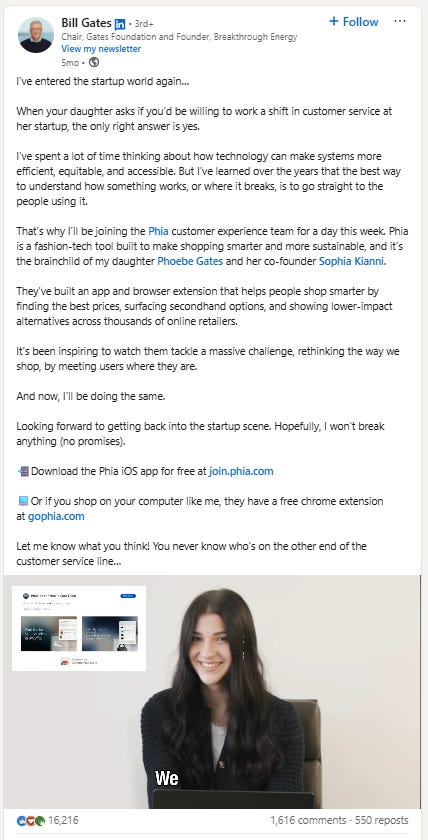
Nepotism takes up space. A spot at the table, a slot on the call sheet, a headline in the press cycle, and millions in allocated capital. Every time a mediocre person gets through the door because of their last name, someone else (often more talented, often more deserving) gets locked out. There are people whose ideas we’ll never hear, whose films we’ll never see, whose companies never got funded because they didn’t have the right connections or even a basic safety net. But hey, that’s just the way the world works, right?
It’s a tale as old as time, but that doesn’t mean we have to accept it. Great ideas, world-changing art, better solutions die every day in someone’s Notes app because dad couldn’t just loan them tens of thousands of dollars (see Phil Knight and Jeff Bezos).
The issue isn’t that privilege exists. It’s how people refuse to acknowledge it, and then, when they achieve success, appear to immediately forget the leg up they had. Wouldn’t we all feel a bit better if starlets with famous parents started their award acceptance speeches wth “I’d like to thank my amazing parents for giving me this platform, paying for fifteen years of singing lessons, and that $50,000 check.” And even better, what if, when that level of success was achieved, that safety net, or that access, could be shared? Shoutout to LeBron James and his foundation for the investment in kids in his hometown of Akron, Ohio.
Make Your Own Safety Net
Privilege is runway. Your background, your family money, your network, these are pieces of your life that allow you to try things and fail, and keep trying without major consequences. Gracie Abrams told us that the safety net gave her time to experiment. The funded kid got to be bad at something for years until they were good at it. Most of you never got that window. Nobody is going to hand you a rich dad. A safety net, though, is buildable, and that is the part I can actually help with. Think of your emergency fund as runway. It is the number of months you can afford to be bad at something new before it starts paying you. Six months of expenses buys permission.
But cash is the slowest piece to build and the most obvious, so do not stop there. When you don’t have a backstop, every fixed cost you cut buys another month of runway without earning an extra dollar, which means the cheaper your baseline life, the longer you can afford to be bad at something.
Use periods of abundance to shore up for future financial famines. Set up your balance sheet to weather the storm of starting a busininess, just in case you want to start one. Open the line of credit or the HELOC while you still have a steady paycheck, because banks lend money to people with steady paychecks, not entrepreneurs in their fourth month of trying to get a business off the ground with no revenue. To be clear, I’m not saying go into a bunch of debt, I’m saying look into lines of credit and see what’s available to you while you have the steady paycheck.
Think about protecting the income you already have. Your future earnings are the single biggest asset you own, and an own-occupation disability policy is the thing that keeps one bad diagnosis from wiping out your runway entirely. It is the catastrophe most people forget to insure against. Did you know that back pain is the number one disability that prevents people from working?
Here’s another idea: fund a Roth IRA and treat it as a stealth backstop while you are at it, because your contributions, not the earnings, come out tax and penalty-free whenever you need them. The same dollars can be your retirement and your break-glass money at once.
Don’t forget the other stuff. Your network! Stay in touch with the people who would vouch for you before you actually need the favor. Get a second stream of income going so that one boss is not your entire runway.

If you have privilege, whether it’s financial, social, or reputational, use it to bring others in. And I don’t mean performatively through a once-a-year donation to a charity that will make you feel good and reduce your tax liability. Really bring them in. Recommend them for the job. Ask who’s missing from the table and do something about it. Privilege is a bad thing when those who have it are blind to it or pretend it doesn’t exist.
And if you don’t have that kind of privilege? Don’t waste your energy tearing down the people who do. Instead, get close to it, learn from it. This doesn’t mean we stop criticizing broken systems. It means we stop letting resentment knock us off our chosen path. Resentment is exhausting.
I’m guilty of this, too. In financial services, my business partner and I built our firm from scratch. Our dads didn’t run a firm where we spent summers working in and eventually take over. There was no handoff, no client list waiting for us. No network. I catch myself side-eyeing advisors who inherited their practices from their parents. What a leg up. But that reaction isn’t about them. It’s about me and my feelings of superiority because of how hard I believe I worked. My frustration with how uneven the starting lines can be. That doesn’t make my work more virtuous. It just makes me human.
We fixate on individuals because they’re visible. But the problem isn’t one founder or one famous daughter. The problem is a system that rewards proximity to power more than originality. That funds confidence over insight. That keeps wealth and access in the hands of the already rich, already trusted, and already seen. And the algorithms continue to push the most recognizable names to the top.
You don’t have to be the loudest or most connected person in the room. But you do need to be in the room. And if you’re already there, look around. Whose voice could you amplify? Whose project could you back? Whose name could you say when someone asks for a recommendation? If you’re feeling jealous of someone else’s success, try this instead: invest. In yourself, in your work, in someone else’s potential. That doesn’t always mean the stock market. It means time. It means attention. It means capital, when you have it, and curiosity when you don’t. Hit the like button on someone’s business launch instead of texting a screenshot.
Did you ever watch the show New Girl? I highly recommnd, it’s hilarious. There’s a running joke on the show that one of the roommates must put a dollar in the “douchebag” jar everytime he’s being a douchebag. What if you put $100 in your investment account everytime you felt that pang of jealousy over someone else’s success. Let’s all make “jealousy jars” and then use the funds for something meaningful.

And if you’re one of the lucky ones—the well-connected, well-funded, already-seated—do more than acknowledge your privilege. Use it. Feed it back into the system. That’s why people are so angry at billionaires right now. Sure, they haven’t been taxed properly and they are out of touch. But I think it’s because we don’t see enough of them giving real money, real power, or real opportunity to anyone else.
Parting shot: Money changes everything. Not just for the people who have it, but for the people they choose to share it with. So stop tallying who deserves their success and focus on your own.
When looking for that original NY mag article, I was surprised to see Ben Platt’s face. What, he’s a nepo baby? I thought he was just a really good theater kid! See, even I’m guilty of it!
We’ve all got to run our own race. Some people get a head start and it feels unfair. Being rich or connected doesn’t automatically confer joy or ability. There are hurdles that nepos have too. I’m sure it wasn’t easy for Miss Gates to see her father’s infidelities shown to the world.
thanks once again for such a thoughtful perspective! damn this really resonated.. i love the idea that "privilege is runway" because it's a more productive way to think about it vs constantly keeping score of who had it harder/easier. we all start from different places, but at some point the question becomes: what are we building with what we have today? that mindset feels empowering instead of discouraging.