


The rent vs. buy debate, dismantled.
Key takeaways:
Buying real estate is not a guaranteed path to wealth.
It’s not easy to navigate a housing market that was shaped by a completely different economic era than previous generations.
Once you get past the shame you can make the right housing decision.
I want to tell you a secret that the internet, your mom, the loud guy in your work Slack channel, and on that podcast all got wrong: Renting is not throwing money away. Buying a house is not a personality trait of only smart, organized, successful people. And owning real estate is not how most people build real wealth anymore. It’s harder than ever to buy a home due to stagnant wages, ballooning student loan payments, a national housing shortage, and a few other things that are going to take decades to fix.
I want to start by saying, it’s very important to me that you know that you’re not a failure if you don’t own property. And that buying and investing in real estate has a chokehold on the narrative of how to build wealth in this country. It’s not the ONLY way, and in fact, it’s a lot riskier than most people think.
The rent vs. buy debate has always been emotionally fraught, but lately it’s taken on the tenor of a toxic relationship, the kind where you know something’s off, but the sunk costs and social pressure keep you in it. You don't even like hardwood floors that much, and six months ago, you didn’t even know that a co-op was, but now you’re obsessing over how to get into one.
Why this debate is more confusing (and dumber) than ever
We’re all trying to navigate a housing market shaped by a completely different economic era. The original "wisdom" around buying a home came from a world where homes cost $100,000, interest rates were under 5%, and people stayed in one place for 30 years because that’s where their job, family, and bowling league all lived.
That’s not the world we live in now.
In the world you live in, housing prices have doubled in the last decade, mortgage rates have hit a 20-year high, and the “starter home” doesn’t exist in most metro areas unless you want to share a wall with four raccoons and have your living room look out over the town dump. You probably won’t live in the same place for more than five years. You might not even work in the same industry.
And yet, homeownership still gets held up like some kind of ultimate financial benchmark. If you rent, people assume you’re doing it wrong. If you own, you probably had help from your parents, and all your friends hate you…or you're panicking quietly about cash flow.
This is where things get messy, and also where I come in.
Team Rent vs. Team Buy
For the past four years, my business partner John and I have run this very popular webinar called Rent Vs Buy, where we go head-to-head, debate-style, and talk about the pros and cons of each. We’ve been through a zero interest rate environment, a pandemic, tax law changes and so much more in these four short years but the talking points remain relatively consistent. Let’s go ahead and give this the “which Hogwarts house are you?” treatment, shall we?
Team Rent: You value freedom, flexibility, and not draining your bank account on a roof repair. You’re not trying to build equity in a depreciating asset. You want a place to sleep and a home to keep in a city you love.
Team Buy: You crave stability, control, and the psychological thrill of being able to mount a TV without asking permission. You have cash for a down payment, and you know with 110% certainty that you’re staying put for at least a decade.
Here's what’s important: neither team is inherently smarter or more “grown-up.” It’s just that one is better for your actual life, and if you’re not 100% sure which team that is, that’s okay too.
Let’s start with Team Buy: The fantasy
Buying a home is often sold as “the American dream,” but in reality, it’s more like buying a very expensive used car you have to live inside.
The benefits of buying are real and can be an integral part of building real wealth: building equity, tax breaks, and long-term stability.
But the numbers only work if:
You plan to live in the home for 10+ years
You have a large enough down payment to avoid PMI (private mortgage insurance)
You pick an area and somehow time the market well to ride a dramatic increase in property values
You can afford ongoing maintenance (because you are now your own landlord)
You aren’t over-leveraging yourself in a bidding war with people backed by a large cash gift from Daddy Warbucks
If even one of these isn’t true? The math breaks.
Let me be very clear: real estate is not a guaranteed path to wealth. There are too many risk factors. And yes, you could get lucky—maybe you bought in Austin in 2008 and sold ten years later, right as a wave of tech companies moved in. Or maybe you picked up a fixer-upper in a gentrifying pocket of Philadelphia, held on through the lean years, and walked away with a six-figure profit. Maybe you bought in Boise before the pandemic boom. These success stories exist. But they’re outliers.
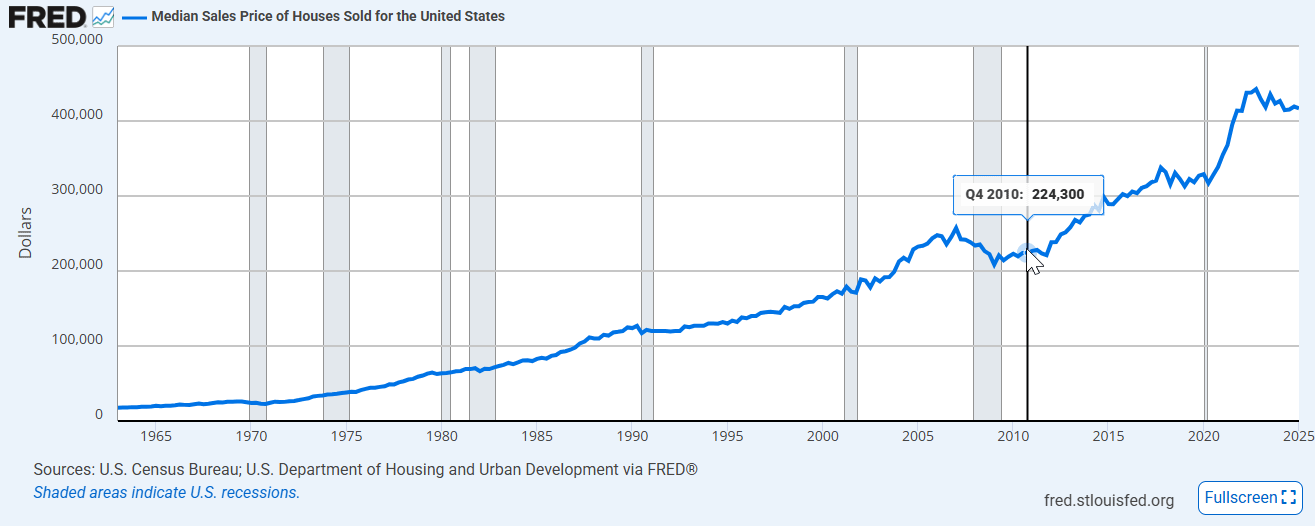
Nationally, home prices appreciate at an average rate of about 4% per year. That’s slower than the stock market—and it requires a lot more hands-on work. Here’s the national average home sale price data from the St. Louis Federal Reserve.
Let's break down a theoretical example here:
Average Purchase Price (2010): $224,300
Sale Price (2024): $419,300
Time Held: 2024 - 2010 = 14 years
🧮 Summary:
Total Increase: $195,000
Overall Growth: ~86.9%
Average Annual Increase: ~4.62%
86% growth seems huge but 4.62% average annual increase isn’t so great. Also, this doesn’t factor in things like property taxes, maintenance cost, and mortgage interest paid. My point is that selling a home for TWICE what you paid seems so dramatic. It seems like a huge win…but in reality the annual growth actually falls short of other investing classes…like stocks.
Historically, the stock market does better on average. Some say as low as 8% annually. Depending on which data set you’re looking at, the average annual growth can be even higher.
For every breakout real estate success, there are stories like the couple who bought a condo in Miami in 2006 at the peak, only to watch it lose half its value after the housing market crash in 2008. Or the families who bought new builds in Las Vegas in 2022, then saw prices fall as interest rates soared and demand cooled. Or those who lost their homes entirely in the LA wildfires, the Houston floods, or the increasingly frequent “once-in-a-century” disasters.
Real estate can absolutely be a part of a strong financial plan. But it’s not a cheat code. It’s not magic. And it’s not immune to risk.
Also, this may sound obvious, but it’s worth saying out loud: if you wouldn't want to live somewhere without the appreciation potential, then you shouldn’t be buying.
Now let’s talk about Team Rent: The smart decision no one congratulates you for
If buying a house is “adulting,” then renting is seen as the financial equivalent of still eating cereal for dinner. That’s dumb, and it’s for the “have-nots.”
Renting is, in many ways, a power move. You get the benefits of shelter, location, and lifestyle without tying up hundreds of thousands of dollars in one illiquid asset.
When clients ask me if they’re “wasting money on rent,” I ask them this: Would you say you’re wasting money on food or transportation?
Rent is not a waste. It’s a cost, just like anything else you pay for that gives you access to something you need. You are paying for flexibility, mobility, and freedom from having to replace your own HVAC system.
And most importantly, if you rent instead of buy, you can invest the difference.
Which brings us to the part no one likes to hear.
Investing beats owning
When we run the numbers, renting and investing often beats owning in terms of long-term net worth. Why? Because the stock market has historically returned more than residential real estate, especially after you subtract mortgage interest, taxes, insurance, and repairs.
But people don’t think about this because real estate is visible wealth. You can touch it. You can post it on Instagram. Your parents understand it. As I like to say, you can’t throw a stock market portfolio-warming party.
Investments, on the other hand, are quiet. They sit in your account, compounding in peace, while your cousin complains about property taxes.
That doesn’t mean no one should ever buy. But it does mean that the why has to be stronger than just "because I feel like I should."
Okay, but what do the numbers actually say?
I get it. You want numbers. So let’s do a quick run of the New York Times Rent vs. Buy Calculator, which answers the question: At what point does buying actually beat renting financially?
This is one of my favorite tools that I’ve used dozens of times in client meetings.
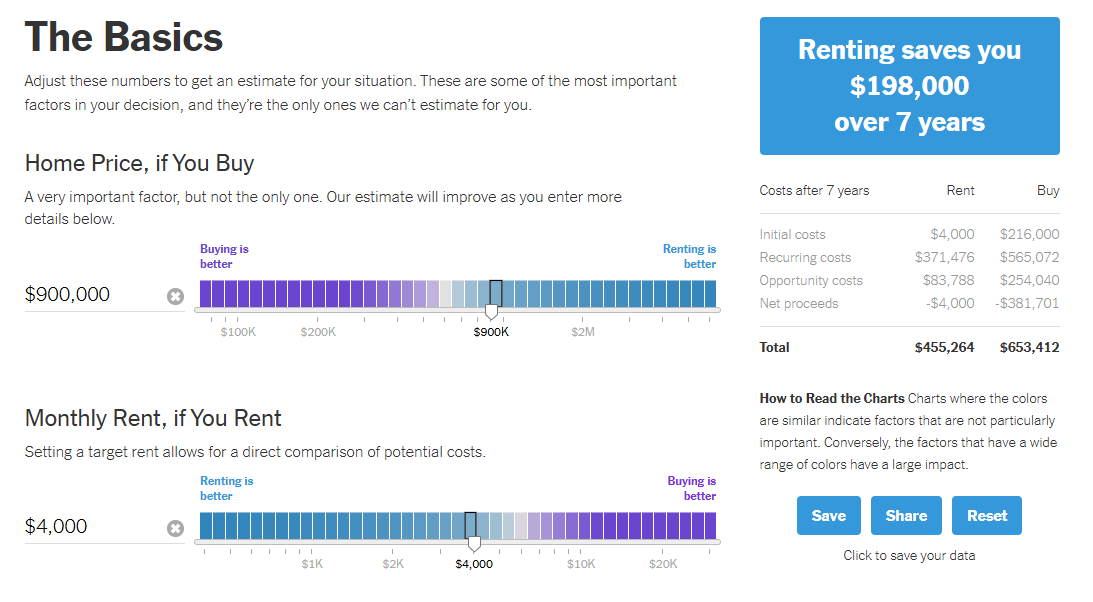
Here’s our baseline scenario:
You’re looking at a $900,000 apartment in Brooklyn
You’ve got a 20% down payment ($180,000—which, let’s be honest, not everyone has just sitting around)
Mortgage rate: 7% (because the Fed hates us)
You plan to stay for 7 years
Property taxes: $800/month
Maintenance/HOA: $1,200/month
Comparable rent: $4,000/month
Investment return (if you rent and invest instead): 8% annually
Now here’s the result:
Renting comes out ahead unless you stay in the apartment for more than 13 years.
Yes, really. Even though you’re shelling out $4,000/month in rent, you’d still build more wealth renting and investing the difference because your invested money is working harder than your home equity ever will, especially in the early years when mortgage interest eats most of your payment. But you do actually HAVE to invest the difference, that’s the key. You have to be disciplined enough to actually make contributions to your stock market portfolio.
And this is using conservative estimates. No bonkers NYC co-op special assessments, no surprise plumbing emergencies, no massive stock market booms. Just plain math.
The New York Times calculator takes into account the full picture: mortgage interest, closing costs, opportunity cost of the down payment, property taxes, inflation, and a realistic rate of return on your invested money. It’s the closest you can get to what a financial planner would actually do (minus the part where we ask you how emotionally attached you are to having a breakfast nook).
Why does this matter?
Because the myth of homeownership as the ultimate financial move is still alive and well, even though in many real-world scenarios, renting + investing gives you a better outcome. And way more flexibility.
This doesn’t mean buying is bad. It means buying without running the numbers is bad. It means buying because you “feel like you should” or because you’re scared of rent increases is not a strategy, it’s a coping mechanism.
So… how do you decide?
Here’s a quick rubric, based on dozens of client conversations:
Buy if:
You’re 100% sure you want to stay put for the next 10+ years
You can comfortably afford a 20% down payment and the monthly carrying costs
You value long-term stability more than optionality
You won’t panic when the roof starts leaking, or if home values drop 10%
You will be able to rebuild your household emergency fund within a year to cover emergencies like a leaking roof
You want to plant roots, raise a family, or become the person who owns a lawnmower
You really struggle to save and need the forcing mechanism of a mortgage to build equity
Rent if:
You’re not sure where you want to live long-term
You work remotely or in a field with high mobility
You like optionality, liquidity, and low fixed costs
You want to invest in the market, not in your walls
You can admit that maybe you don’t want to spend your weekends at Home Depot
The shame tax
I want to end with this: so much of this conversation is poisoned by shame.
People feel bad for renting, because they assume they’ve failed some invisible adulting test. People feel bad for buying, because the house is too expensive or too much work or just not what they expected. People feel bad for getting help from their parents, and they feel bad for not having help from their parents.
You cannot win this game by playing someone else’s version of it.
What matters is not whether you rent or buy—it’s whether your money is working for you. Whether your housing costs are sustainable. Whether you’re building wealth intentionally, not just crossing your fingers and hoping the market appreciates.
If you’ve made it this far, congrats. You’re already ahead of the game. You’re thinking about your financial life in a way that most people never do. That’s the point of this newsletter.
And if you’re still not sure whether you should rent or buy, here’s your answer:
Unless you are certain you’ll stay somewhere for a decade, keep renting.
Take the down payment and invest it. Buy a sofa you love. Learn to cook something excellent in a tiny kitchen. Be free.
Parting shot: I hope this post lives rent-free in your head and you can get over the conventional wisdom of home ownership.
Best $20 I spent this week: $8 on travel laundry detergent packets for my upcoming Europe trip.
Renting is buying. It is buying time. Some are not ready to be locked down in one place. Some are not ready for the financial responsibilities of home ownership. Some cannot afford a home, yet. It is an American Nightmare to buy a home you simply cannot afford to upkeep. Where I live rent is more expensive than a mortgage. Where I live finding someone that is decent to rent from is almost impossible. Here is my thing, stop living what someone says you should do and live what your current finances tell you can do.
You have no idea, how much I needed that. I'm almost 40. Just got a new job with a substantial raise, and I have been thinking a lot about my next move. Thank you.