

How Much Should You Spend on a Wedding? Budgeting, Engagement Rings, and Prenup Tips from a Financial Planner

Key takeaways:
There’s no right amount to spend when buying an engagement ring or planning a wedding, however you should not under any circumstances go into debt!
A pre-nup is not an insult! It’s a smart, clarifying, and protective move.
Honest communication with your partner about your priorities is key to building a solid foundation for a shared financial future.
How much should you spend on a wedding? The correct answer is $40,000. That’s the correct answer because that’s MY answer. That’s what I spent, and it was right for me. Your right answer will likely be different.
As a financial planner, I get asked a lot of questions about love, money, and the institution of marriage. My opinion on this subject somehow matters because I suppose my career makes people think that I’m sensible about money…or something? I personally find it a little weird when people ask me how much I should spend on my wedding or how much Brad should spend on the engagement ring.
But I do have a shred of empathy for people going through the process of planning to propose or planning a wedding, because I understand where these questions are coming from: mostly fear. Fear of spending too much, fear of not spending enough, fear of disappointing the love of your life, or your family. I am a lover of weddings, but in my work as a financial planner, I see all the time how an expensive wedding can start a marriage down a rocky path. Even if someone has never been married before, they’ve likely heard the horror stories, watched bad, expensive weddings play out in rom-coms, and know that the big event usually comes with a large price tag. Most people also have a pretty strong opinion of what they want their wedding to be like, but often don’t have the means or the wherewithal (aka standing up to your mother-in-law) to make the wedding that they’ve always envisioned happen.
There’s the courthouse wedding (estimated price: $2,000): inexpensive and easy. It’s romantic and feels very special. Maybe you have dinner, just the two of you at the restaurant you had your first date at.
There’s the destination wedding in Europe (estimated price: $300,000). Maybe you dream of walking down the aisle in a field of lavender in Provence, a 15th-century castle in the background, while 150 of your closest friends sit waiting, all dressed in lavender as well? Or, there’s the traditional wedding (estimated price: $100,000). Maybe you want to honor fourteen centuries of tradition and let your mother-in-law plan the big ass Indian wedding, you’re just along for the ride.
This is all to say that all relationships and the personalities within them are unique, so there is no right answer to the question of “how much should I spend on a wedding?” However, I do think a framework is helpful for figuring out how to approach planning the wedding you’d like to have, since there’s nothing quite like planning a wedding to make people lose their damn minds.
Between the flower budgets, joint bank account debates, and the Googling of “Is a prenup unromantic?”—marriage is still, always, a financial decision.
Marriage has never just been about love. In the olden times™, it was about cattle and farmland and bloodlines. These days, it’s more about health insurance, estate access, and whether your student loan payments will tank your partner’s debt-to-income ratio. And I suppose love is a factor in there, too. However, while the economics may have changed, the core principle remains: marriage is a merger.
So if you’re getting married this summer, or next summer, or maybe the summer after that: Congratulations! Now let’s talk about money.
Step One: Talk. Early, Honestly, and Often.
Some of you are already uncomfortable. Good.
Money is emotional, yadda yadda, you’ve heard this before. The way we think about money is tied to how we were raised, what we fear, what we value, and what we think we deserve. That means your partner’s attitude toward money—whether they’re frugal, generous, obsessive, or avoidant—isn’t an accident, but instead has been shaped over time by forces outside of your control. And the same goes for your own attitude towards money, as well.
That’s why choosing a partner is the single most important financial decision you’ll ever make. (More on that here.) Having a partner that you can communicate clearly with about your expectations for your wedding and your future together is a solid foundation to build from.
Before you pick a venue or say yes to a dress, have the big talks. Do you have debt? Do you want kids? Would you ever quit your job to care for a parent? How do you feel about spending $25 on a salad? $4,000 on an apartment with more space? How about if someone’s father offered you $50,000 to spend on a wedding or a down payment, are you aligned on your decision for how you’d want to use the money? Remember: You’re not just marrying your partner, you’re likely becoming a part of a larger family. And if it’s a family with purse strings, expect them to be pulled.
These conversations are foundational. And they’ll make or break your financial life together. So talk about the wedding and your expectations before you get engaged. You’re adults (hopefully), and this is a big thing and it deserves to be given serious attention.
Do You Need a Prenup?
Probably, yes. Especially if you will AT ANY POINT IN THE MARRIAGE own a business, expect to receive an inheritance, or just don’t want to burn down your life if the marriage ends. I hear people object to prenups so often, saying things like, “we’re both broke, so there’s nothing to protect.” Yeah, okay, duh. A prenup is not about what happens if you get divorced tomorrow; it’s about showing each other that you’re responsible partners and will look out for each other’s best interests even decades into the future. Getting one is especially important for business owners or for those generating intellectual property.
A prenup is not an insult. It’s a blueprint for how you’ll protect each other if your love changes or fades over time. It’s a grown-up move made by people who understand that financial clarity is a gift, not a curse. Check out online tools like HelloPrenup if you’re nervous or don’t know where to start. Or call a lawyer. A good one.
The Sparkly Lie of Engagement Rings
No, you do not need to spend three months’ salary on a ring. That “rule” was invented by someone in the marketing department of a diamond company1 and has been drilled into people’s heads by a diamond industry that has helped exploit entire communities and ecosystems. The real rules are: Buy what you can afford and be sure to add it to your renter’s or homeowner’s insurance policy. You have the receipt for the big purchase, so often for just a few dollars a year, you can add specific jewelry to your policy in case your $6,000 diamond ring goes down the drain in a dishwashing disaster. Often, renters' policies will cover up to $1,500 of jewelry in the event of theft, so if the ring costs more than that, it’s probably a good idea to add it. Also, please, don’t go into debt to buy the ring.
The most common question I get from friends is“how much did your husband spend on your engagement ring?” And my honest answer is that I don’t know. I remember when we talked about getting engaged, and I sent my husband this gorgeous rough-cut diamond and gold ring I had seen in London. I think it was $12,000. He said something along the lines of, “That’s beautiful, but are you sure you want something that big?” I knew he was right. I wanted something I could wear every day forever, not just during our engagement, and he knew that. He also knew that he wasn’t planning on spending that much and wanted to gently let me know. That didn’t bother me, but maybe it bothers you? Again, this is all very emotional stuff, so just talk about it. If there’s a ring you’ve dreamed about since you were a little girl and you won’t be happy until it’s on your finger, then let your partner know. If you’re not aligned on this one thing, get ready for a lifetime of resentment and disagreement. Sorry to be so cynical, but this is your first big purchase, and it’s a decision that in my opinion, should be made together.
So, How Much Should You Spend on the Wedding?
As much as you want, as long as you don’t go into debt.
Like so many things to do with money, there are trade-offs. There’s the guy who has a good job and makes good money, but still lives in his parent’s basement and drives a $100,000 car because it makes him happy. What you spend your money on is nobody’s business but your own. But with weddings, the stakes are high and there are more parties involved than just the couple getting married. There are the families who often expect to be included in the planning and/or in the guest list selection in exchange for paying for some or sometimes the entire wedding. Weddings are different in every culture, and many young people getting married are less into the traditions of their parents, or are putting their own spin on the ceremony. Whichever route you choose, just know that other people will have an opinion about your wedding, and you may have to make some compromises to keep everyone happy. But at the end of the day, you should do what you and your partner feel the most comfortable with.
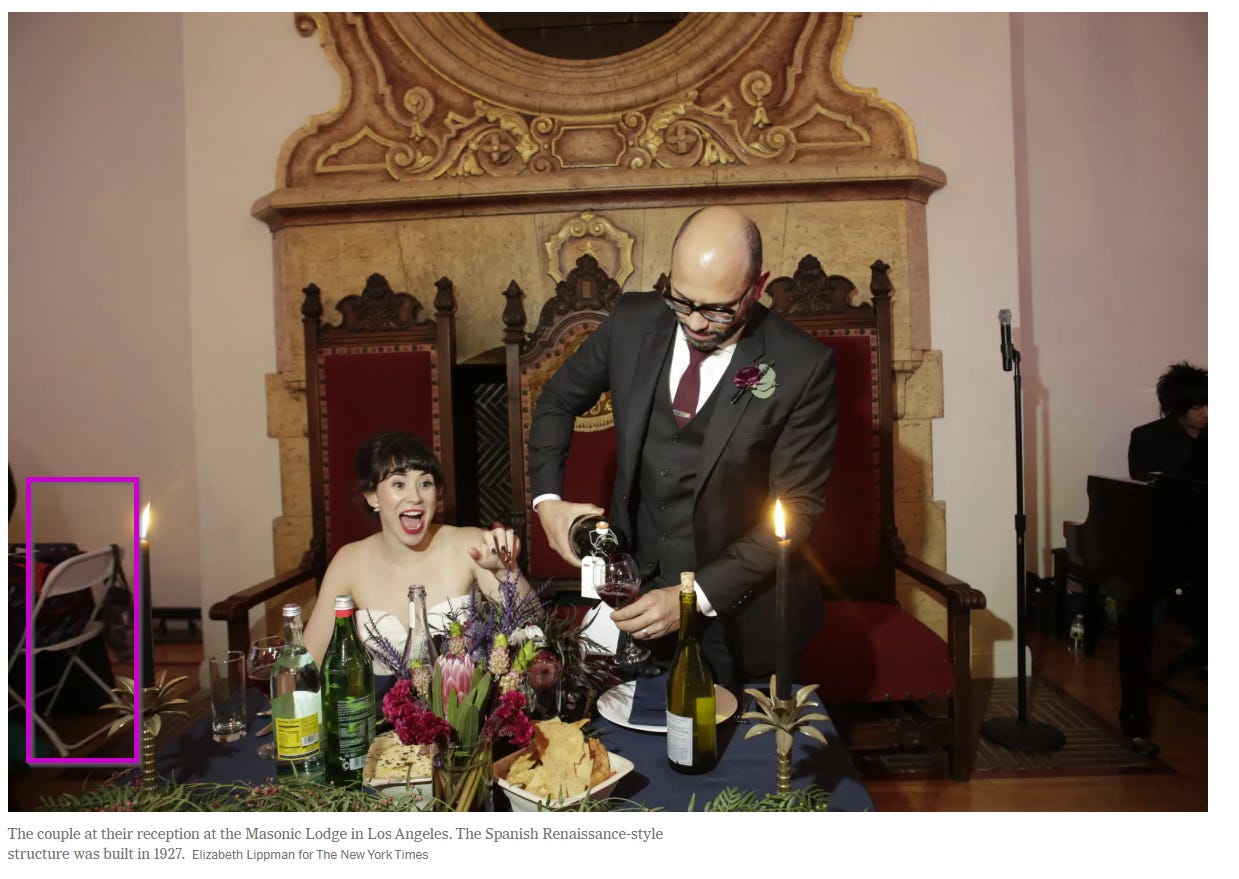
I loved our wedding. We spent $40,000 on it, and it was beautiful and very us. There were parts that were very traditional and parts that were weird. We saved on some things and splurged on others. I only have one regret: we rented these cheap metal folding chairs instead of upgrading to the fancy bamboo ones, which would have cost another $2,000. The cheaper ones don’t look great in the photos of the dining area, but you know what? It’s okay. I put that $2,000 towards the most fabulous hotel I’ve ever stayed in on our honeymoon. See? Trade-offs!
Remember, comparison is the thief of joy. So instead of measuring your budget against someone else’s, start with what you want and what’s important to you (ideally before you make the Pinterest board). If you’re a regular reader of this newsletter, then you should know by now that I love to use a framework to help make financial decisions, so here’s one for your wedding budget. If your budget is unlimited, good for you, go crazy. Most of us are dealing in trade-offs and compromises, so this is for you.
Below I have a list of things you will likely consider when planning a wedding. You and your partner should take this list and prioritize from #1 - #15, with #1 being the most important thing to you.
One of you might think that having a live band is non-negotiable. The other just wants enough money left over for a decent honeymoon. One of you cares deeply about the flowers. The other didn’t even realize flowers were a thing.
This is the moment where you get to learn—maybe for the first time—how your partner spends money on joy.
These exercises are the beginnings of building a wedding you actually want, rather than one that feels like a financial group project gone wrong.
You’ll likely start to notice themes: one of you cares more about the party, the other cares more about the ceremony. One wants a huge guest list, the other wants something small and meaningful. This is not a fight. It’s a negotiation—and one that mirrors the next 50 years of your shared life.
Here are some things worth ranking, discussing, or at least acknowledging:
Guest list size
Location (city, venue type, travel logistics)
Food and drink
Music (DJ, band, playlist, live harpist?)
Photographer and/or videographer
Flowers and decor
Attire (dress, tux, multiple outfits, nothing fancy)
Invitations and paper goods
Lodging or transportation for guests
Ceremony details (religious? secular? self-written vows?)
Reception vibe (sit-down dinner? cocktail party? backyard keg?)
Cake or no cake
After-party or no
Welcome drinks, brunches, and all the extras
Honeymoon plans
You don’t have to use my list, make up your own! Each of you should write down the things you care most about for the wedding. Separately. No peeking. No “whatever you want, babe.” Be honest. Write the stuff you want, not what you think you should want. Then come back together and compare.
Once you’ve settled on your wants and priorities, it’s time to go deeper. Ask the annoying but clarifying questions:
Do we want this because we actually want it, or because it’s what we think weddings are supposed to include?
Who are we trying to impress?
Are we spending money on memories, or just stress?
Once you’ve talked it out, rank everything together. Pick the top three things you’re willing to splurge on. Those are your financial North Stars. These are the things that deserve time, attention, and room in the budget. The rest? Cut back, get creative, or cut out entirely.
For our wedding, the venue, food, wine, and music were most important. We got married in this beautiful venue that happened to be on the grounds of a cemetery. I loved that it was a little morbid. My husband and I have been to so many weddings where there are dozens of appetizers and the dinner comes out when everyone is drunk and not that hungry, so we decided we’d do some sort of inexpensive Mediterranean food. Something that would taste good at room temperature. We also worked with a raw space, so every piece of flatware and cutlery had to be rented. So we asked the caterer to bring paper plates! GASP!? Paper plates at a wedding?! You know what, no one cared. I loved the food, and so did many of the guests. Another weird savings for us was the cake. We didn’t have one. I didn’t want to serve coffee, but certain older family members insisted, so we did it. I don’t think anyone really drank it. Ohh well!
Also, here’s the truth no one likes to say out loud: cutting the guest list is the single most effective way to reduce wedding costs. So if your guest list is ballooning—cut it down. A smaller wedding isn’t less special. It’s just more honest about your priorities.
I am a financial advisor, not an advice columnist (or therapist), but I have had my fair share of relationships, and I’m pretty sure I have a great marriage. So I will say this: don’t expect things to change just because you get married. I find that people often put too much pressure on a wedding to draw an invisible line to say: now we are married, and because we had this huge, expensive party, we can now start our real relationship. That’s not how it works. A wedding is just a happy celebration, and your partner isn’t going to magically change their behavior just because you got married. A marriage makes the relationship official in the eyes of the courts and the IRS, but it’s up to you and your partner to decide what it means for you. I’m not trying to be a downer here, but if you’re expecting your wedding to be a forcing mechanism to get your partner to stop going out so much, or to get their shit together to get a better job, you are going to be sorely disappointed. That’s all to say, have the big wedding, spend as much as you want, but just know that it’s okay to get married quickly and quietly. It’s okay to disappoint your parents and elope and be with each other.
Parting shot: The right amount to spend is what leaves you with no regrets, and no debt.
The best $20 I spent this week: This app Whering mimics the Clueless closet outfit generator. It’s free!
Rule of thumb: the more expensive and elaborate the wedding, the shorter the marriage.
DSO and I got married on a shoestring in a small private ceremony many decades ago, not spending much, but very much in the company of a few people we valued.
We’re among the last of our friend cadre to remain married, and we attribute it to stripping out the trappings and focusing on each other. Those people who had destination weddings, big themed weddings, etc…..have not fared as well, by and large.
Neither of us is perfect but we reinvest our energy back into the relationship….which also aligned with long-term investment activity. We’re not rich (or retired) yet, but we should be able to cross that line in a couple of years.
Really enjoyed this article and wish I had seen it during my wife and I's engagement (11+ years ago!).
The three clarifying questions resonated with me. I remember feeling such a tremendous amount of pressure to do what was "expected" - mostly from family dynamics on both sides. Which ended up dictating so many financial decisions. Asking those questions would have brought things into focus.
Hopefully this article reaches a lot of engaged couples out there!